
All postsEXPLORE TOPIC

#music

Making it, listening to it, recording it, all that

IKEA hacking for the studio

Any time that I spend recording these days tends to be remote, and mixing happens 100% in the box. So loading up the rack spaces in my mix desk with outboard gear doesn't make a lot of sense. Maybe it would if I had some rackmount synths, but I don't. I previously traveled to remote gigs in a giant Odyssey mixer case with 9 spaces on top and 6 on the bottom. It's ridiculous, even after adding casters, and near-impossible to load into the truck without risk of a hernia.

But even the smallest portable rack case is crazy expensive for my purposes. I'm not going on tour. I'll move it occasionally from recording location to studio and back, but it's never going "on the road." So after looking around I finally found this simple "IKEA hack." Conveniently, the Rast table is 19" wide on the inside and made of unfinished pine. Assembled as-is with some rack rails attached, it'll hold 6U worth of rack gear. But a slight modification lets it hold 8U. I added handles and a flourescent light in the back, spray painted it black, et voila, a stupid-simple case.

With the bigger items like my ART preamp, there isn't a lot of horizontal room left, but if I ever did this again I think I'd move the rack rails a little farther inside so the knobs were more protected. And for $15 at IKEA, I suppose I could make another attempt.

Cost breakdown:

  • IKEA Rast - $14.99
  • Rack rails - $6.96 x 2
  • Spray paint - $3
  • Handles - $3 x 2
  • Total: Under $45

Closest thing I could find pre-made: $130
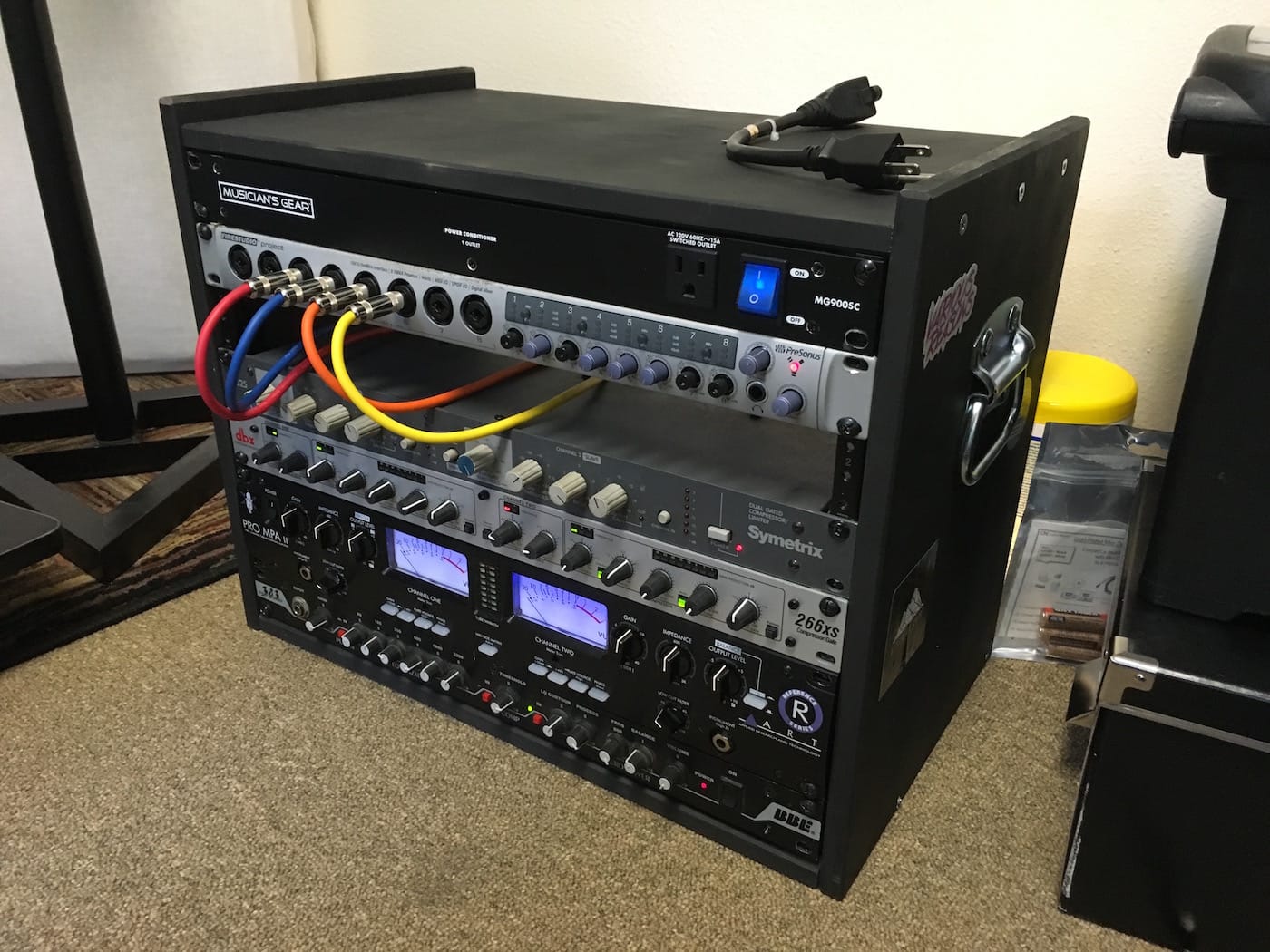
FYI, my el cheapo signal chain, from the bottom up:

  • BBE bass EQ and preamp. I dislike the Sonic Maximizer and the "BBE Sound" in general, but this thing will even out a crappy bass guitar and give it some sustain and punch.
  • ART Pro MPA II (Gold Edition) mic preamp. ART get no love, but their black 2U tube units (MPA, VLA, Channel) sell for under $200 and they sound good. The Gold Edition swaps tubes for a less hissy gain. I mostly use it on vocals, but if you have to record a guitar direct it'll give you real tube gain, which will make any plugin amp simulator sound that much more authentic.
  • dbx 266xs compressor. I believe the "xs" stands for "extra shitty" when it comes to dbx's model line, but honestly it's still a dbx compressor. Which means it's pretty transparent and easy to use as well. For vocals I'll dial in some light compression when recording, but it's useful as a limiter as well if that's all you need.
  • Symetrix 525 compressor. I guess these things were originally for radio (duck the music as the DJ talks) but the sound is pretty darn good; I tend to use it to fatten/lengthen the sound of snares. Symetrix compressors have the distinction of being ultra-cheap (now and forever) but somehow approved by the GearSlutz community as useful tools.

Presonus Firestudio Project. I now have two of these interfaces because they're that good. For the money, it's almost impossible to beat the Presonus stuff. Decent gain on the preamps (could be better for vocals but that's what the ART is for), low noise, and pretty configurable and versatile. Chaining two is a breeze and gives you 16 mic inputs and 10 stereo outputs for a good bit less than a grand. I have never actually done remote recording with all 16, but in theory you could do a pretty good sized band at once.
Discuss

Switching to Studio One

💡
9 years later, I'm still on Studio One, even though it's called Fender Studio Pro.

I recently worked to record my band's new EP, and decided to do something I don't normally have the opportunity to do when someone's paying me: I changed my DAW.

Backstory: my Mac is starting to become inoperable due to the longstanding need for operating system updates. Recently Chrome decided it didn't like my version of Mac OS anymore. But if I start moving to the California editions, I have to switch to Pro Tools 12. And if you don't know what that means, imagine moving from Adobe CS to Creative Cloud. Yeah, I sunk a lot of money into Pro Tools and I'm not really into paying $25 a month or $300 for a year at this point.

So, I pulled out some old You Might Think We're Sharks base tracks from our last session that never got overdubs, and finished "Summer Moon" in Presonus Studio One, which I've been threatening to switch to for a while.

It went well, so I recorded An Empty Room's new one on it as well. There are some tradeoffs, but overall it's just a better experience and I wish I'd done it sooner. One thing I missed from Cubase is that the music creation and mixing portions were well integrated. In recent years since dropping Cubase, I tend to compose in Ableton, then finalize and mix in Pro Tools. In Studio One, though it's obviously not the same as Ableton, I'm able to integrate composition, tracking, and mixing pretty well. That works for our workflow since we'll add synths and samples in the mix process after doing the tracking.

The Pros:

  • Native compatibility with my hardware, which is made by Presonus as well.
  • Almost everything is faster. To send tracks to a bus, just select them all, right click, and select "Create Bus from selected tracks." No more routing.
  • Track presets and plugin groups (so you can save an entire chain of plugins that you use often).
  • Stock EQ has a frequency analyzer.
  • VSTs and AUs are invariably cheaper and more available than AAX.
  • Comping is incredible. Just highlight each part of the take ("Layer" in Studio One) you want to promote and it's done.
  • Fades are automatic (like Ableton), and they can be tweaked with bezier curves, as can automation.
  • Dragging and dropping, in most cases, replaces menus and routing. Even importing audio files: just drag them in, and when you save the file Studio One asks if you want to copy the audio files to the project directory.
  • As of version 3.4, there is a Smart Tool just like Pro Tools.
  • Macros.

The Cons:

  • I miss the single-stroke keyboard shortcuts. Leaving the modifier keys behind always made me feel like my keyboard was transformed into a spaceship control center. There are a few in S1, but not as many.
  • By that same token, keyboard focus is sometimes wobbly. You can search for plugins in the Insert/Send menus, which is amazing. But you can't reliably use the keyboard to select the one you find, and I end up selecting tracks, soloing them, etc.
  • Audio stretching is unintuitive.
  • No Beat Detective equivalent that I know of. I didn't use it that much anyway.
  • Nothing like Xpand! in the Artist version, but I recently picked up the VST version for a buck.
  • That's... about it.

I'm currently using Artist Edition with the iPad remote and VST plugin support upgrades. Most of the features that I would love to have in Pro Edition are not things that Pro Tools even had, like the Arranger Track.

Overall, it was a small curve, a relatively painless experience, and I didn't lose much for features. Certainly didn't lose any fun.

Discuss

Don't Do It, No. 2137

Don't name your band after people that a lot of your audience considers the villains if you don't have any idea what you're talking about. Further... if someone calls you on it, at least pretend you did know what you were doing at the time (ex: George Lucas, who said 100% that the rebels were the Viet Cong), otherwise you're just a tool. It's almost like #145, "Don't pretend you don't understand why your use of Nazi imagery bothers everyone." (Hi Iceage).

Discuss

Discovering, weekly

I love Spotify's Discover Weekly. It's incredibly outstanding. It's just about the best recommendation engine I've ever come across, save maybe Last.fm's. The mix of science and crowdsourcing behind it is fascinating; no wonder it works. It's even replaced Last.fm as my primary recommendation method, although to some degree that's because it's a push based system where I don't even have to try. It's always there for me.

Is there a downside to this? I don't really see one. In theory, people used to rely more on others to get their recommendations. This still uses your friends — and people you don't even know who share your current taste — to push recommendations to you. I actually liberally spam my friends with albums, too. I'd wager that if you were the type to do that before, you're still doing it, and if you weren't, you're getting more recommendations now.

There's a criticism that anything algorithmic is going to by its nature be "safer" and work within a set of boundaries, whereas randomly listening to college radio can break you out of your existing sonic box. I suppose that's valid, but I listen to such a wide variety of genres and popularity levels on Spotify that I don't really get that effect. Here's some stuff on the rock end of the spectrum I discovered using the playlist.

The Drink (dark twee folk-prog?)
(oembed: https://www.youtube.com/watch?v=EjMK6hMIFuo)

Milk Music (YouTube commenter gets it sorta right for once: "Sounds like the Wipers joined CCR and played Husker Du covers)
(oembed: https://www.youtube.com/watch?v=CPc5tHUn4ww)

Sheer Mag (whose record my friend Adam in Cleveland mastered)
(oembed: https://www.youtube.com/watch?v=Pr2um9KXkgQ)

🫠
Edited many years later: Shame about this, huh?
Discuss

New Impercept EP

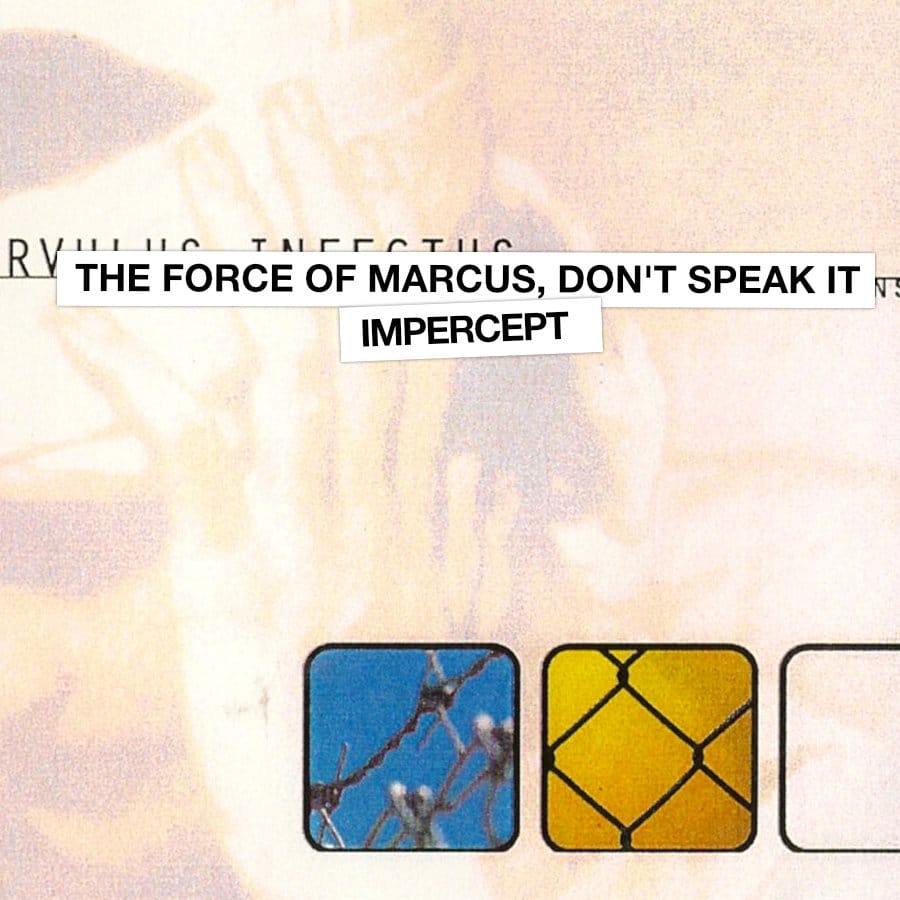
I spent a lot of time a couple months back experimenting with the new version of Reaktor. It doesn't actually work on my studio computer because it requires Yosemite, so it was something I could handle while at home on my newer Macbook Air (which runs Reaktor surprisingly well). For a cover and the title, I blasphemed the only Parvulus Infectus album released while we were together. It's maybe inspired by Bowie's cover for The Next Day.

Check it out here.

Have a listen, and maybe like Impercept on Facebook for more of my musical experiments that don't logically fit with one of my bands.

Discuss

Live recording with local band the Nouns

Building up a portfolio of recorded, mixed work is not always done by traditional routes. That's especially true when your primary selling point as a recordist is mobility. I would probably love to get nothing but mix jobs — the work is fun, solitary, and low-pressure as long as you meet deadlines — but the challenges that take me out of my comfort zone are a big part of what make recording interesting.

The Nouns are a hip-hop and jazz crossover with elements of rock and R&B. They have a level of accessibility that jazz groups don't often achieve, and their talent level is sky-high. Their lineup consists of drums, keys, bass, sax, jazz singer (with some R&B/soul flavor) and an MC.

My strategy would be to mic them up for multi-tracking but not to get too angsty about bleed. They performed in a barely acoustic-treated music classroom at the University for a video shoot.

Challenges

The first unique aspect of this session would be running live sound in a small room while simultaneously recording. The drums didn't need amplification, and the bass and keyboard player both had amps. So I piped everything through my computer in the normal recording chain and produced two separate mixes. I ran a mix of just vocals and saxophone out to three channels of the PA for "house" sound. Then I gave my headphones everything. This worked surprisingly well with Presonus's Universal Control. It enables up to 4 mixes, but it's notoriously crash-happy the more you do with it. Thankfully, it held together enough to give me a 3-channel PA routing while recording all 8 channels of audio.

The bass and keys were easy to record: their amps had DIs and I recorded them direct. I loathe DI'd bass sound most of the time, but a little love from EQ in the mix usually helps and practicality won the day this time.

Mics

For the sax, a Beta 57 positioned a few inches off the bell and at the middle of the horn gave me a surprisingly good sound with minimal effort. I got tonality, articulation, and detailed reediness.

I stuck a pair of SM81s in an XY pattern over the drummer's head. I was able to get them fairly close, given that he's a jazz drummer with little to no arm swing. The XY of course keeps everything in phase, but it turned out to be a great fit for a unique kit. He uses two snares side by side, and no toms. I supplemented the kit with my old Oktava LDC in the front of the kick. The resulting sound has maybe more room sound than I would care for, and the hats are a bit wild on a couple songs, but it serves the musicality and dynamic range of the jazz style playing.

The singers each got an SM7B. This is a mic I had no experience with but I was pleased. Though it's a dynamic, it has a lot of detail and really requires a preamp to pull everything out of it. I put it through my cheapo ART Tube MPA preamp (tube-swapped to minimize noise) and my Symetrix 525 compressor/gate. I only took the biggest peaks off; the SM7B's sound is so smooth, it almost sounds like it's been hit with a compressor already. The MC gave a great delivery, and I cranked the tube preamp to give him a touch of grit. I had so much drum bleed in the singer's mic that even the gate wasn't helping. It's possible I should have switched her to a handheld, but even changing her position in the room may have helped. You live and learn. At the end of the day, though, an LDC would never have worked and an SM58 wouldn't have been very exciting.

Mix

I've been into the idea recently of "console-style" mixing. Initially I tried in the obvious choice, the new (v3) version of [Harrison Mixbus](http://harrisonconsoles.com/site/mixbus.html), but despite some huge improvements in performance it's still not quite ready for primetime. I will continue to experiment with it.

Slate

The "console" mentality proved a great way to justify trying out the new Slate subscription plugin program. While Avid is getting a lot of flak for moving to a subscription based model for all versions of Pro Tools going forward, Steven Slate is proving that execution (and a lot of brand good will going into it) can make all the difference.

The Slate VMR and VCC really tied the sound of all the tracks together, and the 3 EQs (SSL and Neve) and two compressors (Opto and 1176) available in VMR are about what I'd normally use. Since this project wouldn't be mastered, the Slate FG-X would let a non-mastering-engineer like myself put the final touch of volume and polish on the tunes.

Other Plugins

Despite the closeness of the overheads, I feel like the XY pattern gave me a bit too much room sound and the room really wasn't a great one. So I hit them with a bit of Tokyo Dawn's Proxmity plugin, an ingenious combo of reverb, compression, and EQ that can make sources sit closer or farther away in the mix. For the bass, I shamelessly applied Waves Renaissance Axx compression going into the Slate VMR. Surprisingly, I didn't use the Maag EQ4 on the singer. This had a lot to do with the drum bleed throwing unwanted frequencies into her mic; I needed to do more surgery on specific frequencies. The Maag has smart frequencies but they're fixed.

Roundup

This was a challenging recording situation. But with the exception of a few specific issues, the mix came together well. So I might have done something right. More than any other session, Shure saved the day. The Beta 57, far from being a "just good enough" versatile mic, was magic on the sax. And I can understand why the SM7B is such a popular microphone. But the stars of the show were really the SM81s. The simple drum mic setup worked great for jazz, and might make me rethink how I deal with a rock kit next time.

Discuss

RIP the man who fell to earth

Probably doesn't come as any surprise to anyone that I am, and have been for as long as I can remember, a David Bowie fan. I heard the news early on because I was up late on Sunday night. We all regarded the first tweets skeptically, because people "die" on Twitter all the time and there was a big death hoax with the release of The Next Day. But it was verified sadly by his son, the director Duncan Jones. Suddenly his new album took on a new significance. The lyrics aren't cryptic anymore, just like that. And in roll the thinkpieces and tributes.

It's only in hindsight that I realize what songs like "Rock 'n' Roll Suicide" and "Life on Mars?" did for me as a nerdy, weird, depressed kid. Bowie probably changed my path — for the better.

Somehow the ultimate outsider hero also cut across so many types of people that the response was near-universal. I suppose everyone feels like an outsider, and he managed to tell them "oh no love, you're not alone."

Discuss

The Rebirth of Swans

In 2007, I had seen pretty much every Angels of Light or Michael Gira solo tour that had happened since the breakup of Swans. I was pretty burnt my missing the final Swans Are Dead tour so I took every opportunity. Then Gira released a new Angels album with Akron/Family as the backing band. It's all fairly repetitive and hypnotic compared to earlier Angels of Light records, but "Black River Song" in particular kind of exploded my mind when I heard it. Combined with the cover art by Deryk Thomas, who also painted Love of Life and White Light From The Mouth of Infinity covers, it all added up to Swans. I couldn't stop listening to the tune, and probably telling everyone I knew that this meant Swans were coming back.

At the advent of the Swans reboot, Michael Gira repeatedly told a wonderful yarn. Seth of Akron/Family hit a huge chord on stage and it made Gira realize that he wanted more Swans. But when I listen to this tune, I still feel like it was there, dying to get out. And given that he's done what might be his best stuff since the reboot, I'm pretty glad it was.

Discuss